Vera Molnar

Vera Molnar (1924–2023) was a pioneer of digital and algorithmic art, whose practice intersected geometry, conceptualism, and emerging technologies. Widely recognized as one of the first artists to systematically explore rule-based image-making, Molnar laid the groundwork for what would later be called generative art—decades before digital tools became widespread. Her work is rooted in the tradition of geometric abstraction and shaped by the influences of artists like Piet Mondrian, Kazimir Malevich, and Paul Klee. Yet, she deliberately distanced herself from the dogma of Constructivism, carving out an individual position somewhere between anarchic systems and conceptual rigor.
After moving to Paris in 1947, she became part of a vibrant network of artists experimenting with Concrete and Kinetic Art, including François Morellet, Julio Le Parc, and others. During the 1960s, she began developing her own visual systems using the most elementary means: paper, ruler, compass, and index cards. These early analog experiments were guided by sets of strict rules—geometric compositions defined by seriality, repetition, and variation. She was interested in creating images that appeared as if they were produced by a machine, even before she ever touched a computer.
This is where her concept of the “imaginary machine” (machine imaginaire) comes into play. Coined by Molnar herself, the term describes a fictional machine in her mind—an abstract entity she would mentally program with a system of rules and parameters to guide the creation of an image. The imaginary machine allowed her to simulate generative processes without technical means: it was a cognitive strategy, an internal engine of artistic production, grounded in logic and abstraction. This approach allowed her to distance herself from subjective expression and instead explore the aesthetic potential of constraint and variation.
In 1968, Molnar began working with computers at the Sorbonne, one of the first artists to do so. Using early mainframe systems and plotter printers, she translated her imaginary machine into real algorithms—often written in collaboration with computer scientists. Her interest was never in the medium itself, but in what it could offer to the systematization and extension of visual possibilities. The machine was a tool for thought, a way to push beyond intuition and enter new territories of form, rhythm, and randomness.
Molnar’s “imaginary machine” thus becomes a central metaphor in her artistic practice—one that continues to resonate in the context of contemporary digital and generative art. Rather than relying solely on technological novelty, her work consistently emphasized structure, critical distance, and conceptual clarity. Over decades, she remained committed to the core principles she had established early on: reduction, repetition, and visual logic—always open to disruption, error, and the aesthetic surprise that emerges from a calculated rule being slightly broken.
Today, Molnar is widely recognized as a visionary figure in the history of computational art. Her works—ranging from early plotter drawings to later digital prints—reveal a lifelong engagement with the tension between order and disorder, the hand and the machine, the imaginary and the real.
-
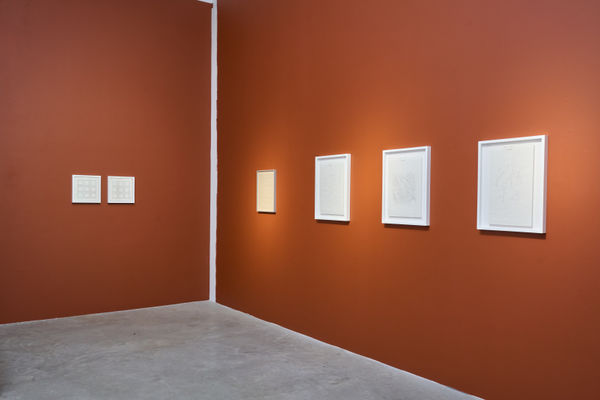
 25 carrés, 1990
 -
9 carrés, 1986
-
9 carrés, 1986
-
9 quasi-carrés (réf. 85B), 1985
-
Interstices oranges, 1985
-
Structure de quadrilitares, 1985
-
Segments et leurs croisements (75.039-11.16.26), 1975
-
Segments et leurs croisements (73.146.11.41.17), 1973


-
Vera Molnar and Harm Van Den Dorpel - 1% of Disorder
New York 27 Feb - 28 Mar 2026Lohaus Sominsky is pleased to present 1% of Disorder , an exhibition presenting the works of Vera Molnar and Harm van den Dorpel. The works in the exhibition create a...Read more -
Vera Molnar - IMAGINARY MACHINE
Munich 4 Jun - 6 Sep 2025Vera Molnar (1924–2023) was a pioneer of digital and algorithmic art, whose practice intersected geometry, conceptualism, and emerging technologies. Widely recognized as one of the first artists to systematically explore...Read more -
Harm van den Dorpel and Vera Molnár - ANGLES MORTS
Munich 7 Sep - 2 Nov 2024In the exhibition ‘Angles Morts’, LOHAUS SOMINSKY is showing new works by the artist Harm van den Dorpel in combination with works by Vera Molnár, who is known for her...Read more


-
Press
vera molnar, harm van der dorpel October 9, 2024SÜDDEUTSCHE ZEITUNGvon Evelyn Vogel 09.10.2024 Auf den Spuren der Algorithmen - Codes und KI haben viel mehr mit Textilkunst und dem Weben zu tun, als...Read more -
The Brooklyn Rail
Vera Molnar July 11, 2024Vera Molnár: Parler à l’oeilRead more -
Artsy
Vera Molnar March 6, 2024Vera Molnar, Mother of Computer Art, Pioneered the Future of AbstractionRead more -
Le Random Art
Vera Molnar February 26, 2024Vera Molnár moved to Paris at the end of 1947 and would call the city home for the rest of her storied life. Use our...Read more


-
Pompidou+
Vera Molnar February 5, 2024AI, NFT: Vera Molnár, a step ahead: As early as the 1960s, Vera Molnár was exploring the infinite possibilities of computer-assisted art. A few months...Read more -
Art Forum
Vera Molnar February 1, 2024THIS PAST DECEMBER, pioneering computer artist Vera Molnar died at the age of ninety-nine. To celebrate her achievements—and to mark the opening of a major...Read more