Ilit Azoulay

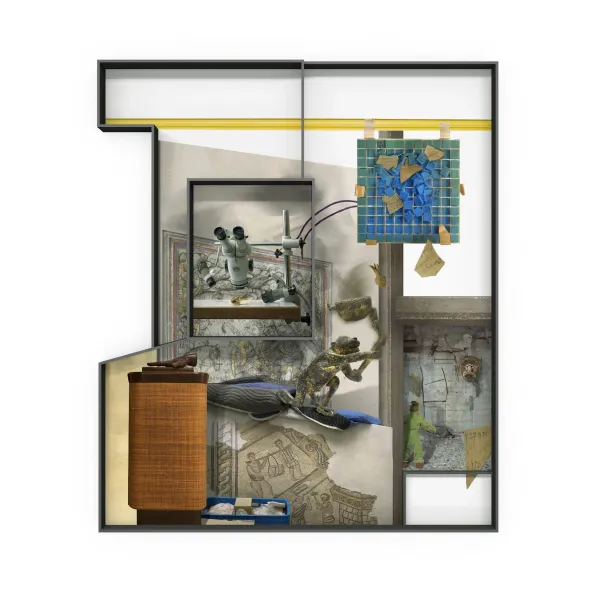
Azoulay received a classical training in photography, but ever since she completed her MFA she has critically confronted the norms of photography imposed by a paradigm, developed in a male-dominated industry, that the medium should capture a decisive moment. On the one hand her post-produced images inscribe the photographic process in duration, while on the other it alters the photographic perspective induced by the use of a single lens. Azoulay is best known for pioneering a photography technique aimed at recomposing an image according to the data issued from a thorough research process.
Her work, Room #8 (2011) is a single post-produced ten-meter long panorama and is composed of thousands of digitally assembled macro photographs. It is no longer possible to assess the position or temporality of the photographer for she vanishes behind the grid.
“.... the grid has become iconic of this tense. It is not the grid of modernism, presented as an image of utopian and autarkic autonomy; nor that of postmodernism, reproduced as both a model and a product of ceaseless mechanical movement; nor that of architecture, structured in scaffolding form; it is not even the common, trivial grid habitually used to instill order. No, for Azoulay’s grid lends itself to communication with any and all of these grids, only so long as it remains utterly committed to the establishment of foreignness and distance between the images of these objects and whoever faces them.”
Perhaps more in affinity with “female” weave craft, Azoulay addresses and critiques the Darwinist notion of progress that undergirds the technicity of photography. She often refers to “the one man in the first daguerreotype who was unknowingly photographed, not only because he did not know Daguerre was pointing his machine at him but simply because the technology was not part of his understanding of the world yet: Daguerre was invisible while gathering information.”
Obviously, today it is hard to find a person who is unaware of the camera’s eye and places that aren’t under its scrutiny. But if we look again at this daguerreotype, it appears that the others, those strolling on the Boulevard du Temple at a normal pace were left out of the image, for their pace was too quick for the chemical solution to record their figure.
“It is precisely who did not make it to the visual realm of immediacy dictated by the technical progress that interest me: ‘undeveloped silver halides’ dwelling in the darkness of the past, under layers of time, years of oblivion. Non-processed data of which the story can only be recovered piece by piece.”
With the help of researchers and witnesses, her work is developed on a textuality functioning as data. Rather than critically addressing the administration of data and its unchallenged technological rendering of images, she often proposes other strategies of data gathering and image rendering. A good example of her exhibition strategy can be found in Shifting Degrees Of Certainty, 2014 that was shown at MoMA’s exhibition, Ocean of Images in 2015. Photographic fragments carefully organized on the wall of the museum each bear a number that when pressed in the provided audio-guide, delivered a story about the particular fragment and how it came about. The viewer was ushered into 85 different stories offering as many paths as the artist traced during her research.
“It does not create objects but rather discloses HOW an object has come about and shows why and how this disclosure gives itself as art. Searching for its objects and researching without end the non-appearing sources of their occurrence, the “double law” of this method invents a wholly other SPHERE where the objects and their histories happen WITHOUT method. As if objects and their histories were happening outside, before and beyond any and all space-time coordinates. As if thus objects and their histories required other performatives irreducible to the spatio-temporal synchronicity and, cast outside this synchronicity, they, the objects and their histories, finally reveal themselves WITHOUT END.”
In Azoulay’s work, no element is simply found, but its origins traced and sensed. None of her work is photography in the straightforward sense of the term. Each element in her highly constructed images, even the most banal looking piece of concrete or dust, is carefully considered and (dis)placed. Her composite and multilayered images allow for a parallax view of several layers across time and space and are inscribed in the record of a duration.
-
 Report 004: I know where to stand if I don’t want to be seen right away., 2026
 -
KAELIS , 2026
-
ENSALA , 2026
-
ILARA , 2026
-
KARYON , 2026
-
KERANA, 2026
-
LAMYA , 2026
-
LAYALA , 2026
-
NERAYA, 2026
-
ORAMA, 2026
-
ORIS , 2026
-
ORMEL , 2026
-
Panel 1, 2022
-
Panel 10, 2023
-
Panel 2, 2022
-
Panel 5, 2022
-
Panel 7, 2022
-
RANKALA , 2026
-
Record 001: Is this the version you know?, 2026
-
Record 002: Is that how it looked from where you stood?, 2026
-
Record 003: Is this the blue you remember?, 2026
-
Record 004: Is this how it looked from your side?, 2026
-
Record 005: Did you witness the whole thing?, 206
-
Record 006: Did you look long enough?, 2026
-
Record 007: What did you notice exactly?, 2026
-
Record 008: Did you see the same thing?, 2026
-
Record 009: Which version reached you first?, 2026
-
Record 010: Did you see it before or after?, 2026
-
Record 011: What did your eye return to?, 2026
-
Report 006: : It happened like that. And still, other angles remain, 2026
-
Report 007: This is where I began to notice, 2026
-
Report 008: I kept all the parts they edited out, what were you hoping to find?, 2026
-
Report 009: Sometimes I think I’m the story, sometimes I think I’m just the footnote, 2026
-
SELARA , 2026
-
TALIS, 2026
-
TANIRA , 2026
-
TARENA , 2026
-
ZARNA , 2026


-
FUTURE ANCESTORS / SILENT MATTER
Ilit Azoulay and Alicja Kwade 15 May - 27 Jun 2026LOHAUS SOMINSKY presents in cooperation with MENNOUR Paris an exhibition of two female artists - Ilit Azoulay and Alicja Kwade - as a contribution to this year’s edition of “Various...Read more -
IM PORTRAIT
Munich 10 May - 28 Jun 2025The portrait, both as a classical medium of individual representation and in its abstract, fragmented, and digital forms, remains a compelling theme in contemporary art. Our exhibition IM PORTRAIT brings...Read more -
Ilit Azoulay - QUEENDOM
Munich 4 Mar - 6 May 2023LOHAUS SOMINSKY is honored to present Ilit Azoulay's latest exhibition, QUEENDOM, after its debut at the 59th Venice Biennale. QUEENDOM is a world imagined by Azoulay, where art reigns supreme,...Read more


-
EXHIBITION
Berlin Art Week - Ilit Azoulay September 5, 2025We are taking part in this year’s curated exhibition of Berlin Art Week at Wilhelm Hallen. The large-scale installation Panick in Lack of Event by...Read more -
Group Exhibition
Ilit Azoulay May 1, 2025Group Exhibition at Forum Kunst im Deutschen Bundestag WIR Commissioned by the German Parliament and inspired by Article 4 of the German constitution, this work...Read more -
Book Launch
Ilit Azoulay April 7, 2025Ilit Azoulay – Facts and Tales – Truth Be Told Ilit Azoulay's new publication Facts and Tales – Truth Be Told has just been launched....Read more -
Scholarship
Ilit Azoulay February 27, 2025Ilit Azoulay receives the Ellen-Auerbach-Stipendium for photography 2024.Read more -
Group Exhibition
Ilit Azoulay February 26, 2025Ilit Azoulay is part of the Central festival exhibition of EMOP Berlin – European Month of Photography 2025. 28 Feb — 4 May, 2025 Opening...Read more -
Museum Acquisition
Ilit Azoulay January 25, 2025Now Part of the Collection: Museum der Moderne Salzburg We are happy to announce that a work by Ilit Azoulay are now part of the...Read more -
Exhibition
Ilit Azoulay December 11, 2024Stopover December 12, 2024 - March 2, 2025 Villa Stuck Goethestrasse 54, 80336 Munich, GermanyRead more -
Review
Ilit Azoulay - Mere Things October 4, 2024Review of Ilit Azoulay's 'Mere Things' Exhibition at the Jewish Museum New YorkRead more -
Site Specific art
Ilit Azoulay October 1, 2024Digital Amnesia or Constructed Memory' by Ilia Azoulay has found its permanent home at Munich's historic Maximilian-Gymnasium. The installation showcases a panoramic photomontage and an...Read more -
Press
Ilit Azoulay September 16, 2024A ‘Jewish Mona Lisa’ — and other myths told by objects found in Israel In Ilit Azoulay’s exhibit at the Jewish Museum, there’s more to...Read more -
Review
Ilit Azoulay - Mere Things September 12, 2024ILIT AZOULAY: MERE THINGS | THE JEWISH MUSEUMRead more -
Press
Ilit Azoulay September 4, 2024‘Mere Things’ Bears the Weight of Jewish MemoryRead more -
Exhibition
Ilit Azoulay - Jewish Museum New York August 14, 2024Read more -
White Wall
Ilit Azoulay May 6, 2022For Ilit Azoulay, The Kingdom Has Crashed. Long Live The Queendom!Read more -
Frieze Magazine
Ilit Azoulay April 19, 2022Ilit Azoulay’s ‘Queendom’ Reconstructs the PastRead more -
Mousse Magazine
Ilit Azoulay December 17, 2021From Ilit Azoulay: No Thing Dies : The Stories We Tell OurselvesRead more -
Art in America
Ilit Azoulay March 7, 2026Read more